Alabama asks Supreme Court to approve its racially gerrymandered maps
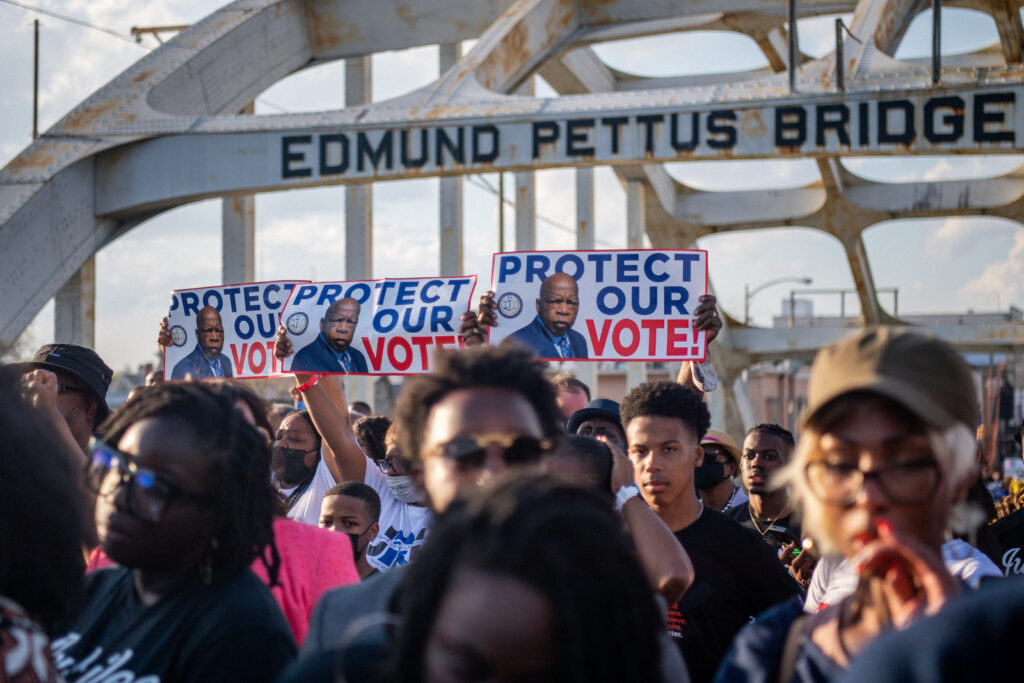
Alabama officially asked the U.S. Supreme Court this morning to pause a lower court’s ruling from earlier this week that blocked the state from using a racially gerrymandered map for this year’s midterms.
That ruling, and Alabama’s filing today, essentially pushes the Supreme Court to show whether it will abide by its new Voting Rights Act standard, established in April’s Louisiana v. Callais decision, which said that maps can be struck if drawn with racial discrimination intentions.
The map that Alabama wants to use this year was drawn by a Republican-controlled legislature in 2023 with the intention to discriminate against Black voters, as courts have found, including the Supreme Court itself that year.
Get updates straight to your inbox — for free
Join 350,000 readers who rely on our daily and weekly newsletters for the latest in voting, elections and democracy.
In that racially gerrymandered 2023 map, Alabama allowed for only one majority-Black congressional district.
However, shortly after its Callais decision, which severely limited the Voting Rights Act’s protections against minority voter dilution, the Supreme Court allowed Alabama to move forward with the 2023 map anyway, despite the fact that voting in this year’s primaries had already started.
But, then a three-judge panel federal district court blocked that map on May 26, saying that it was drawn with the intent to rob Black voters of opportunities to elect candidates of their choice – as it had also found in an earlier ruling.
Alabama asked this morning for the Supreme Court to rule by June 1, if not sooner, on its request to bypass the district court’s ruling so that the state can squeeze in a special election on the racially gerrymandered maps. Justice Clarence Thomas requested a response from Black voters by June 1.
In its filing, the state argued that its maps do not intentionally discriminate against Black voters. It also argued that the Purcell principle – the legal doctrine that says changes such as redistricting shouldn’t be made close to an election – doesn’t apply to legislatures, which can “bear the responsibility for unintended consequences” among voters.
If the Supreme Court allows, a special election has been scheduled for August 11 – a timeline that state’s elections director Jeff Ellrod calls “aggressive,” given his office will have to reassign voters to the new districts, and reprint and resend out new ballots.
But if Alabama’s 2023 maps are approved, it would also mean that the Supreme Court won’t even stop gerrymanders where intentional racial discrimination has been documented, as called for in its Callais decision.