CBC blocks SCORE Act vote on college athlete pay in response to GOP’s southern redistricting wave
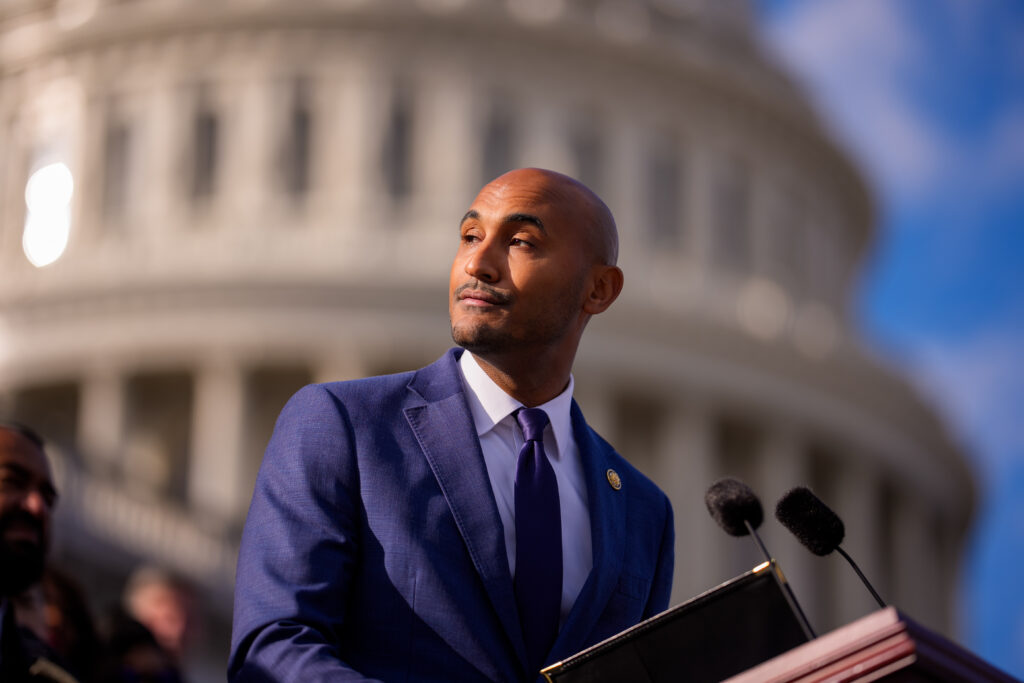
Congressional Black Caucus (CBC) members are blocking a U.S. House bill regarding college athletes’ pay in hopes that collegiate sports associations will speak out against Republicans’ current efforts to eliminate majority-Black districts in wake of the gutting of the Voting Rights Act.
“The [CBC] cannot support legislation benefiting major athletic institutions that continue to remain silent while Black voting rights and Black political power are being systematically dismantled across the South,” reads a CBC statement from earlier this week. “The [CBC] believes institutions that profit from Black talent and Black communities have a responsibility to stand with those communities when their fundamental rights are under attack. Silence in the face of injustice is not neutrality — it is complicity.”
African-American congressmembers are aligning with the NAACP’s call for Black college athletes to boycott colleges in the South, where state efforts are afoot to gerrymander away majority-Black and Democrat districts.
Such efforts hearken historical civil rights causes such as those driven by the Student Nonviolent Coordinating Committee (SNCC) in the 1960s to involve Black students in the crusade for equal democracy and voting rights in the U.S.
Get updates straight to your inbox — for free
Join 350,000 readers who rely on our daily and weekly newsletters for the latest in voting, elections and democracy.
Republicans already have redistricted congressional maps in motion in Texas, Florida, North Carolina, Alabama and Tennessee – with new maps pending in Louisiana, South Carolina and Georgia.
This was all done at the behest of President Donald Trump who last year called for red states to redraw their maps to give the GOP an outsized advantage in Congress. Those same southern states all happen to be where some of the NCAA’s largest and most profitable college football franchises exist.
The U.S. House was expected last week to bring forward the Student Compensation and Opportunity through Rights and Endorsements Act (SCORE Act), a bill providing a national framework for college athlete compensation that has bipartisan support.
The bill was drafted in part by two CBC members, one of whom is Rep. Shomari Figures (D-Ala.), whose state is currently being gerrymandered and could get stripped of its Black districts, including his own.
But Figures, along with CBC member Rep. Janelle Bynum (D-Ore.), recently announced they were pulling their support of the SCORE Act, as did the full complement of the CBC behind them – which, for now, has killed the bill.
“What is happening in America right now should be a wake-up call to everyone. The big-time conferences, especially in the South, want our babies’ lungs, but don’t want their voices,” said Rep. Bynum in a statement. “They want the power of their bodies to score a touchdown, but will look away when they ask for their freedom to walk into the voting booth.”
A 2021 Supreme Court decision allowed college athletes to finally collect pay for their play, after decades of allowing universities to profit tremendously from using students’ names, images and likenesses, and from multi-billion dollar television deals.
Alabama is ranked the ninth most profitable college football program in the U.S., according to The Wall St. Journal, with 2025 revenue of $192,000,000 and a market valuation of $1.4 billion.
Texas, which was the first to redraw its congressional map last year to do Trump’s bidding, has the top two most profitable college football programs, Texas and Texas A&M universities, which brought in $298,000,000 and $218,000,000 in 2025 revenue respectively.
The Supreme Court’s late-April Callais decision blew the door open for Republicans’ sweeping redistricting schemes, allowing them to redraw maps without considering how minorities would be able to vote for politicians who represent their political choices and interests.
“In the wake of the Supreme Court’s Callais decision, states across the South have moved rapidly to redraw congressional maps in ways designed to dilute Black voting strength, weaken Black representation, and undermine decades of hard-fought civil rights progress secured through the Voting Rights Act,” reads the CBC’s statement on its SCORE Act opposition.
The Callais ruling also created a new Voting Rights Act formula that said intentional racial discrimination must be proven to invalidate maps drawn as racial gerrymanders.
However, the high court said in a post-Callais decision that Alabama could now use a map that courts said were drawn with intentional discrimination just two years ago.
“This is an incredibly unfortunate decision by the Supreme Court that not only continues their trend of breaking from the norms and precedents set by the Court, but also sets the stage for Alabama to go back to the 1950s and 60s in terms of Black political representation in the state,” said Rep. Figures in a statement.