South Carolina redistricting: Lawmakers take next step to pass gerrymandered map as election looms
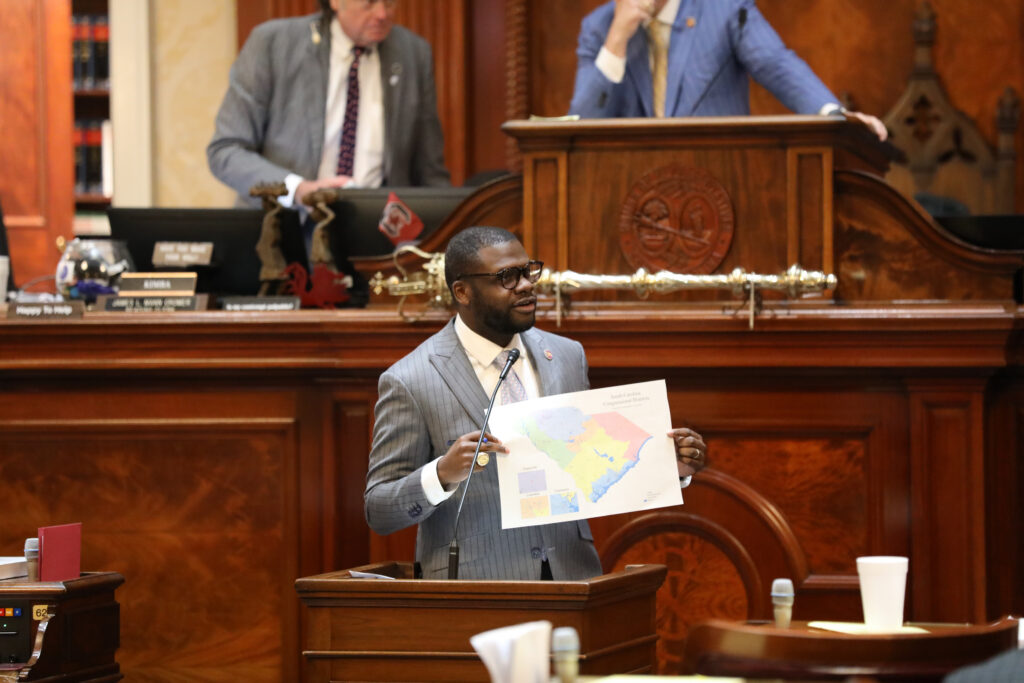
Lawmakers in South Carolina’s state Senate took the next step late Wednesday to quickly pass a new gerrymandered congressional map that dismantles the state’s lone majority-Black district.
In a 15-7 vote, the state Senate Judiciary Committee advanced a new congressional gerrymander, which carves up the state’s only Democratic district — long held by Rep. Jim Clyburn — to give Republicans a favorable chance to represent all seven of the state’s congressional seats.
The map is now headed for a full vote in the state Senate, where it needs just a simple majority to pass.
Earlier this month, a handful of Republican senators joined Democrats to vote against holding a special session for redistricting, which required a two-thirds vote to pass. But the victory was short-lived: Gov. Henry McMaster (R) immediately called lawmakers back to take on redistricting as soon as the legislature’s regular session ended.
Get updates straight to your inbox — for free
Join 350,000 readers who rely on our daily and weekly newsletters for the latest in voting, elections and democracy.
A major point of contention in the rushed redistricting process is the tight turnaround required to pass the new map before the state’s June 9 primary election. Lawmakers attached a provision to the redistricting bill to delay the state’s congressional primary to August 18, so candidates have enough time to file to run in revised districts. But thousands of voters have already cast absentee ballots for the primary.
With early voting set to kick off May 26, lawmakers are under a tight deadline to approve the new map and push the primary back.
During Wednesday’s hearing, South Carolina Election Commission Executive Director Conway Belangia told the committee that more than 2,500 absentee ballots have already been returned — including more than 300 ballots cast by military voters.
To pull off such a feat and push back the upcoming election, Belangia said it would be “very, very, very, very, very tight for us to be able to conduct this process if it goes forward.”
“It is a monumental task,” Belangia added. “Lots of man hours… Any blip causes a huge problem.”
And it’ll be expensive. Belangia estimated that it will cost the election commission between $5.3 and $6 in emergency funding to successfully push the state’s congressional primaries to August.
For hours Wednesday, the committee heard testimony from South Carolina residents who signed up to oppose redistricting. Both Democrats and Republicans took to the podium, one by one, to share their thoughts — including local elected officials.
Will Haynie, the Republican mayor of the town of Mount Pleasant in Charleston County, spoke against the redistricting effort on behalf of his constituents.
“What I’m hearing on Main Street… is that there is a new number one public enemy: And that is this, redistricting,” Haynie said.
The committee also heard testimony from Clyburn’s grandson, Walter Reed, who said his grandfather is “not just a Democrat, he’s a statesman.”
But unlike at previous public hearings, plenty of people testified in support of redrawing the state’s congressional map. Among them: Paul Dans, a former official in the first Trump administration and a leading Project 2025 author.
“I’m wearing the MAGA hat because this is partisan,” he said. “You have a supermajority. Act like it.”
After the committee adjourned late Wednesday evening, it reconvened less than an hour later and voted to advance the redistricting bill just before 11 p.m.
Wednesday’s committee hearing took place hours after the state House rushed to pass the redistricting bill. After a marathon day of debates on the House floor Tuesday, the House passed the new map early Wednesday morning.
Earlier in the week, Democratic lawmakers introduced nearly 600 amendments to prolong voting on the gerrymander — in an effort to run out the clock on the special session before early voting starts for the primary next week. But the House Rules Committee voted behind closed doors late Monday evening to change the legislative process, allowing each member of the state House to introduce only one amendment and strictly limiting debate on each amendment.
The move drew ire from pro-voting groups, who filed a lawsuit challenging the rules change and asked a South Carolina court to block passage of the new map in the House. But a state judge quickly dismissed the legal challenge shortly before the Senate hearing kicked off Wednesday.
“South Carolina lawmakers hid a meeting to change the rules of debate to rush redistricting to rig our election map for partisan gain,” Jace Woodrum, executive director of the ACLU of South Carolina, said in a statement to Democracy Docket about the court’s ruling. “When confronted in court, they argued they are not bound by government transparency laws. No matter what happens next, South Carolina voters will remember the way some of our politicians tried to hide their work while attacking representative democracy this week.”