Voting rights groups accuse Tennessee GOP of racially targeting Black voters in latest gerrymander lawsuit
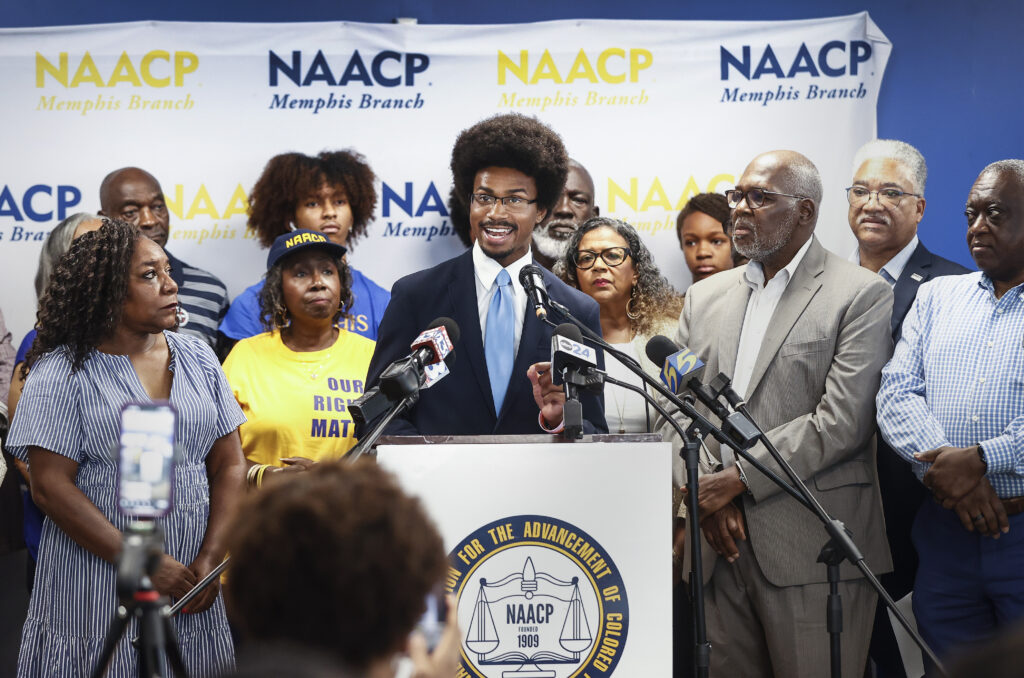
The NAACP and a coalition of pro-voting groups filed a federal lawsuit Wednesday challenging Tennessee’s new Republican congressional gerrymander that dismantled the state’s only majority-Black district just days after the U.S. Supreme Court gutted the Voting Rights act.
The new lawsuit marks a major shift from the NAACP’s first challenge, which focused largely on whether Tennessee Republicans violated state law by rushing through a mid-decade redistricting plan.
This new federal case goes further, arguing Tennessee lawmakers intentionally discriminated against Black voters in violation of the Fourteenth and Fifteenth Amendments.
Get updates straight to your inbox — for free
Join 350,000 readers who rely on our daily and weekly newsletters for the latest in voting, elections and democracy.
The lawsuit targets the congressional map Tennessee Republicans passed during an extraordinary session called by Tennessee Gov. Bill Lee (R). The map breaks apart the Memphis-based 9th Congressional District, which has been Tennessee’s only majority-Black congressional district for more than 50 years, and splits Memphis and Shelby County across three districts that stretch deep into whiter, rural areas of the state.
“This lawsuit goes to the heart of our democracy. Tennessee lawmakers made a deliberate choice to silence Black voters by dismantling a district that has long ensured representation for one of the state’s largest Black populations,” Derrick Johnson, president and CEO of the NAACP, said in a statement. “We are at the dawn of a new Jim Crow era. People fought and died for the representation that lawmakers across the South are so casually eroding. The NAACP will not stand by while elected officials manipulate district lines to take away our political power and silence our voices.”
The federal complaint directly ties Tennessee’s rushed redraw to the fallout from the Supreme Court’s decision in Louisiana v. Callais, which sharply weakened the ability of voters to challenge racially discriminatory maps under Section 2 of the Voting Rights Act.
According to the lawsuit, Tennessee had no new census data, no court order and no population emergency requiring new lines.
“The sole predicate for redistricting was the Supreme Court decision in Louisiana v. Callais that made it more difficult to prevail on claims of racial discrimination under Section 2 of the Voting Rights Act against any newly drawn district,” the complaint reads.
Tennessee became one of the first states to enact a new congressional gerrymander after Callais, moving with extraordinary speed. The complaint alleges lawmakers introduced, debated and passed the map in roughly 48 hours while limiting public input and ignoring warnings from Black lawmakers, civil rights groups and Memphis residents.
“This reconfiguration deliberately ‘cracks’ Black voters and dilutes their voting strength,” the complaint adds. “The Tennessee Legislature was fully aware that these proposed changes to District 9 would deny the votes of, and adversely impact, Black voters.”
The lawsuit also attacks Republicans’ defense that the map was merely partisan, not racial.
The complaint notes that legislative sponsors claimed they relied only on census data to draw the lines. But census data does not show partisan voting behavior.
It does, however, show race.
“The pat claim that the Legislature was merely seeking partisan advantage rings hollow,” the complaint states. “Aside from the false statement about the source of data on which the Legislature relied, the Legislature could have achieved similar partisan results without so drastically carving up a majority Black city.”
Kristen Clarke, general counsel of the NAACP, said the map was designed to erase Black political power in Memphis.
“This is not just about lines on a map — it is about whether Black voters will have a fair and equal voice in our electoral system,” Clarke said. “The evidence is clear: Tennessee’s map dismantled the state’s only majority Black district and was enacted with discriminatory intent. Memphis is home to the largest majority Black city in the country; it is the place where Dr. Martin Luther King was assassinated, and it is a community that deserves to have a voice in our democracy. We will continue to turn to the Courts to beat back efforts to disenfranchise communities.”
The plaintiffs are asking the court to block Tennessee from using the new map and require the state to return to the congressional map adopted at the start of the decade.
Here are a few closing paragraphs you can drop in after the current relief paragraph:
The federal case is now at least the fourth lawsuit challenging Tennessee’s post-Callais gerrymander.
And the fallout from the GOP’s gerrymander has spilled well beyond the courts.
After Democrats protested the map during the special session, Tennessee House Speaker Cameron Sexton (R) stripped all House Democrats of their committee and subcommittee assignments, further weakening their ability to debate legislation in a chamber already dominated by a Republican supermajority.
House Minority Leader Karen Camper (D) called the punishment retaliation.