Court blocks Alabama racial gerrymander from being used in 2026 elections
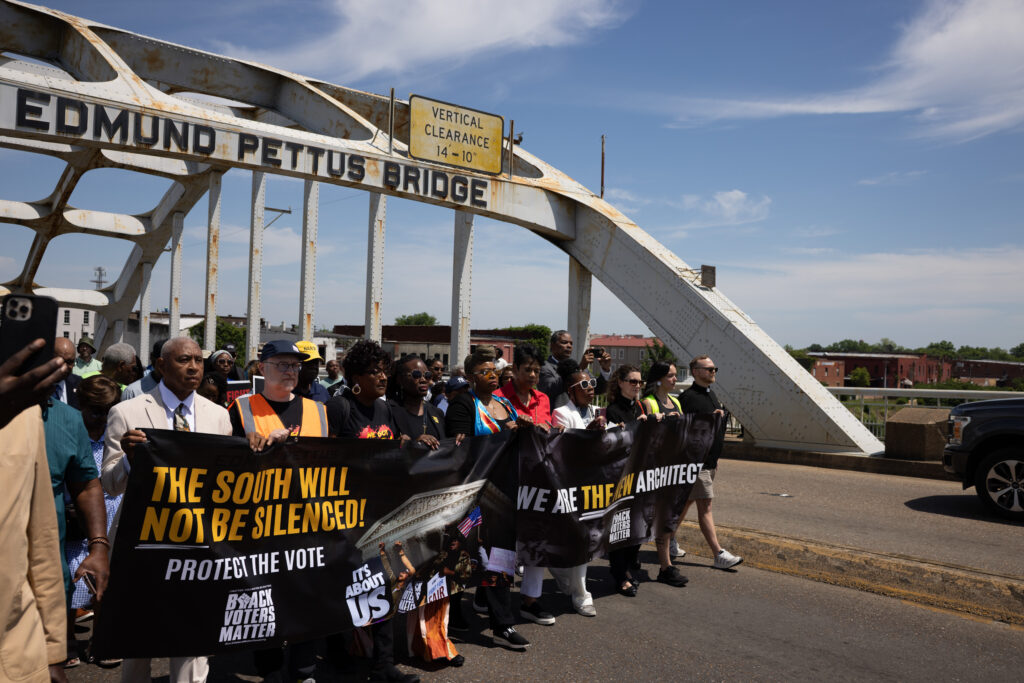
A federal district court Tuesday blocked Alabama from using its 2023 congressional map in this year’s midterm elections, after plaintiffs in a long-running legal challenge asked the court for an emergency order halting the last-minute gerrymander.
The ruling will almost certainly be appealed directly to the U.S. Supreme Court (SCOTUS).
In its decision, the court described the map as “tainted by intentional race-based discrimination.”
When the Alabama legislature initially approved the 2023 electoral districts, it understood that its map would “dilute Black Alabamians’ opportunity to participate in the political process, and it intentionally enacted that very plan,” the court wrote.
Get updates straight to your inbox — for free
Join 350,000 readers who rely on our daily and weekly newsletters for the latest in voting, elections and democracy.
Last month, SCOTUS issued a ruling in Louisiana v. Callais, gutting the landmark Voting Rights Act (VRA), which has restricted racial discrimination in voting for six decades. In the wake of the decision, Alabama lawmakers raced to reinstate their 2023 congressional map, which a federal court had previously struck down as a violation of the VRA’s Section 2 and intentionally racially discriminatory.
In a subsequent decision, SCOTUS allowed Alabama to move forward with using the 2023 map. That cleared the way for the state to change its district lines during an active primary election — even though absentee voting had already begun and caused widespread confusion for Alabama voters.
Black voters swiftly asked a court to block the map. They argued that, even after SCOTUS’ ruling in Callais, Alabama still cannot use a map that the court found to be intentionally racially discriminatory under the 14th Amendment. The federal court agreed.
“Alabama cannot use Callais to legitimize its pre-Callais decision to double down on the discriminatory vote dilution that we and the Supreme Court found,” the court ruled. “And it cannot use Callais to legitimize the series of specific and unusual decisions it made to entrench that dilution. If such retroactive validation strategies were available, States would be encouraged to govern themselves according to what they think federal law ought to be, not what it is.”
Though the map is now temporarily blocked, an appeal will likely send the case right back to SCOTUS.
Alabama’s 2026 congressional primary elections have become increasingly confusing for voters. The state proceeded as scheduled with its May 19 primary, but it postponed four of the congressional races, which are set to be decided in an August 11 special election.
The 2023 map includes one Black-majority congressional district. The district court previously ruled that Alabama should have two Black-majority districts.
The Callais ruling now makes it much more difficult to prove in court that a map dilutes minority voting strength. But legal experts believe — and the three-judge panel today confirmed — intentional racial gerrymanders can still be struck down by federal courts. That indicates that the map Alabama rushed to reenact remains unlawful, even after Callais.
Minority voters have been challenging the 2023 map for years. After Alabama passed the map again earlier this month, they filed motions asking the district court to block the map from being used in the midterms and require the state to use its court-ordered 2024 map, which was drawn in a race-blind manner by a special master.
In a scorching ruling last year, a panel of three federal judges in the case Allen v. Milligan struck down the 2023 map in no uncertain terms, emphasizing the audacity with which Alabama Republicans had not only blatantly discriminated against Black voters, but also openly defied court orders to remedy the violations.
“Try as we might, we cannot understand the 2023 Plan as anything other than an intentional effort to dilute Black Alabamians’ voting strength and evade the unambiguous requirements of court orders standing in the way,” the judges wrote. “After we and the Supreme Court ruled that the 2021 Plan, with only one majority-Black district, likely had the unlawful discriminatory effect of diluting Black Alabamians’ votes, the Legislature deliberately enacted another Plan that it concedes lacks the second Black-opportunity district we said was required. This amounted to intentional racial discrimination in violation of the Fourteenth Amendment’s Equal Protection guarantee.”
They concluded: “It would be shocking for us to hold that a state legislature that intentionally ignored a federal court order for the purpose of (again) diluting minority votes acted in good faith. And it would be unthinkable for us to hold that a state legislature that purposefully took calculated steps to make a court-required remedy impossible to provide, for the purpose of entrenching minority vote dilution, acted in good faith.”