At Senate hearing, GOP plots to minimize power of Black voters after Callais
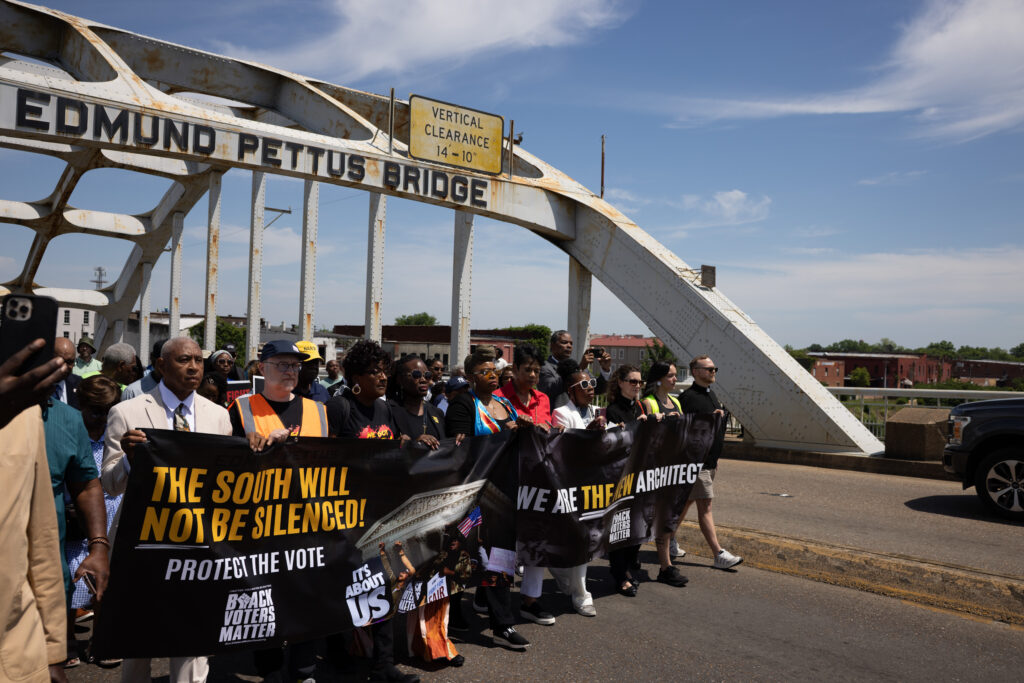
Senate Republicans celebrated the U.S. Supreme Court’s recent kneecapping of the Voting Rights Act (VRA) by plotting paths forward for right-wing lawyers and elected officials to further erode minority electoral power at a hearing Tuesday.
Sen. Eric Schmitt (R-Mo.), the chair of Senate Judiciary’s subcommittee on the Constitution, opened the panel by urging Assistant Attorney General for Civil Rights Harmeet Dhillon to “move immediately, review maps drawn or defended under the old regime, identify districts built on unconstitutional racial sorting, intervene where appropriate, file statements of interest where appropriate, and support plaintiffs enforcing Callais in court.”
Edward Greim, who represented the “non-African American” plaintiffs in Callais, said now it was time “to identify the districts that would fail today under the Supreme Court’s clarified factors” under Callais, noting that districts are not suspect “merely because they are majority-minority districts,” or if they were redrawn to remedy “recent intentional discrimination based on race,” — at least, that is, “until the underlying racial discrimination dissipates.”
Greim also cautioned against seeking redraws via litigation shortly before an election, but noted that “some very notable exceptions” apply to that principle. “The laboring oar is held by state legislatures in many states,” he said, implicitly supporting the redistricting rush now ongoing across the South.
Schmitt described VRA caselaw as “a racial sorting regime, not the rule of law,” that told states “unless they carved citizens into districts by race, they were violating the law.” The Callais ruling, he added, “restored the Voting Rights Act to its proper constitutional role.”
Schmitt mischaracterized the VRA’s history. Signed into law just weeks after civil rights marchers were beaten in Selma, Alabama on “bloody Sunday,” the VRA codified the 15th Amendment’s voting protections for the first time.
Reversing a 1980 Supreme Court decision, Congress amended Section 2 of the VRA in 1982 to ban laws — and electoral maps — that were effectively racially discriminatory, even if they weren’t deliberately so.
Get updates straight to your inbox — for free
Join 350,000 readers who rely on our daily and weekly newsletters for the latest in voting, elections and democracy.
Todd A. Cox, a lawyer with NAACP Legal Defense and Education Fund, countered Schmitt’s misleading narrative in his opening remarks.
“Over the past decade plus, the Roberts Court has eviscerated the Voting Rights Act in Shelby County v. Holder, Brnovich v. DNC, and now Louisiana v. Callais,” said Cox. “In Callais, the Supreme Court substituted its views of the Congress’ considered judgment, repudiating the ‘82 amendments and making discriminatory maps almost impossible to challenge, so long as the state or locality defends its map on partisan grounds or some other grounds that it deems appropriate, thereby entrenching discrimination against minority voters.”
Congress’ intent with the VRA was clear: To ensure that minority votes are not diluted into irrelevance, so that elected officials must attempt to represent their interests, and not just work for the white electorate.
The Roberts’ court ignored that, Cox said.
“Perhaps the most invidious aspect of the decision is the fantasy of a post-racial America that it concocts to support its desired ends,” Cox added. “Every day, Black Americans feel the sting of racism in our lives. The ongoing racism profoundly shapes the landscape of opportunity, including access to fair representation and political power. Yet, without evidence, the Roberts’ Court wishes this world away and pretends we are a nation that has already achieved our highest ideals.”
In the weeks since the ruling, state legislatures across the South – where more than half of the nation’s Black population lives — have sprinted to eliminate majority-Black congressional districts, suspending ongoing primary contests to do so in some cases.
Schmitt said he has already urged Dhillon to target a few state redistricting laws as unconstitutional in the wake of Callais, citing California and Illinois. He said that Illinois law requires districts to be drawn with an eye toward a population’s language preferences. “Does that kind of law tell map makers to think about racial categories from the beginning?” Schmitt asked.
“Yeah, that’s exactly what it does,” said Will Chamberlain, senior counsel at the Article III Project, a right-wing advocacy group that pushes for filling the judiciary with MAGA loyalists. “And again, under Callais, that’s certainly not going to be constitutional.”
While the Supreme Court held that partisan gerrymandering was unconstitutional but a nonjusticiable question in Shelby County, the Callais opinion turned partisanship into a shield protecting maps that eviscerate minority voting power from legal challenges.
Sen. Peter Welch (D-Vt.) repeatedly asked Greim if he supported, “as a citizen,” that system, which lets partisan politicians pick their voters.
“So, you think it is okay in this country that partisanship be the exclusive judgment upon which a majority in a legislature will design the districts in that state?” Welch asked.
Greim declined to offer his support, responding instead it accurately described the current state of the law. “As a citizen and as a lawyer, I understand that’s actually the system that we have actually with the Constitution,” he said.