‘Power grab to erase Black voices’: Southern voting groups vow to fight GOP’s gerrymanders
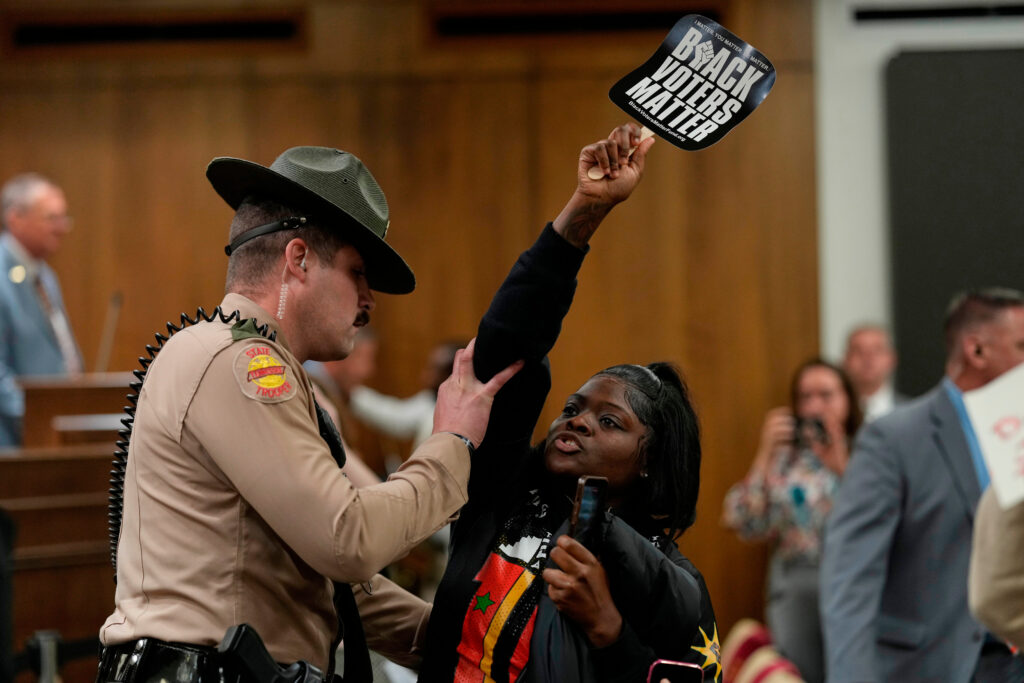
Voting rights organizations across the South Friday pledged to oppose the GOP’s efforts to rig congressional maps in its favor after the Supreme Court gutted a key part of the Voting Rights Act (VRA) last week.
Through a ruling on Louisiana’s congressional map, the court’s conservative-appointed majority significantly weakened Section 2 of the landmark legislation, which for decades served as a safeguard against racially discriminatory electoral maps.
Get updates straight to your inbox — for free
Join 350,000 readers who rely on our daily and weekly newsletters for the latest in voting, elections and democracy.
The ruling has ignited a wave of GOP gerrymander efforts across the South aimed at eliminating majority-Black districts, most of which were drawn specifically to protect the voting power of racial minorities.
“What is happening right now across Alabama, Louisiana, Tennessee, Mississippi — just the broader South — this is not by happenstance,” Anneshia Hardy, the executive director of Alabama Values, a grassroots civic awareness nonprofit, said Friday. “This is coordinated escalation.”
“This moment really echoes the Southern strategy of the 60s, where racial resentment and fear were weaponized politically in response to black communities gaining greater civil and political power after the Civil Rights Movement,” Hardy said.
Tennessee
Tennessee became the first Republican-led state to eliminate a Black-majority electoral district directly in response to the Supreme Court’s ruling.
Gov. Bill Lee (R) Thursday signed into law a new congressional map eliminating the state’s Memphis-based 9th Congressional District, its lone Democratic seat.
Matia Powell, the executive director of the nonpartisan nonprofit CivilTN, said that over 1.4 million voters across the state are now in new congressional districts under the new map.
Many of those voters may not be notified of their new district, because alongside their gerrymander, state Republicans also nixed a state law requiring the government to directly alert voters about changes to their designated polling places when electoral lines are redrawn.
“We have to tell them,” Powell said, though she noted that the situation could suddenly change through legal challenges to the map.
“There are a lot of challenges that still lie ahead,” she added. “We’re pivoting towards education and understanding, and really trying to get Tennesseans turned out. This is not the will of the people.”
The NAACP filed an emergency lawsuit against Republicans’ efforts Thursday evening.
Louisiana
After the Supreme Court’s ruling last week, Louisiana Gov. Jeff Landry suspended the state’s ongoing congressional races even though at least 42,000 voters likely already cast ballots in those races.
This week, the Republicans in the Louisiana legislature considered several different congressional maps, including some that eliminate both of the state’s majority-Black districts.
Speaking from the state legislature Friday, Davante Lewis, a commissioner on the Louisiana Public Service Commission, said the effort was “a power grab to erase Black voices, Black representation, and Black and brown power, particularly here in the South.”
Lewis warned that even though Louisiana has the second-largest percentage of Blacks in the country, Republicans could rapidly ensure that Black voters do not make up a majority in any of the state’s six congressional districts.
“Louisiana took over 45 years to finally desegregate after Brown v. Board of Education, but it took [Republicans] only one week to say they needed to comply with Callais,” he said. “It’s a significant battle, and we are showing solidarity and standing tall.”
Alabama
Republicans in Alabama also embarked on a last-minute effort to roll back Black voters’ political representation before the midterms despite active elections.
The GOP-controlled Alabama Legislature this week passed a plan that would trigger special elections under a congressional map Republicans passed in 2023 if federal courts lift existing injunctions against the map in the aftermath of Callais.
Gov. Kay Ivey (R) signed the plan into law Friday.
Courts previously ruled that the map violated Section 2 of the VRA because it did not include a second majority-Black district. However, after the Supreme Court’s latest ruling, the state asked the federal courts to lift their injunctions, arguing that the Supreme Court’s decision in the Louisiana case has now rendered blocks on the map with two majority-Black districts unlawful.
Hardy said the Alabama legislation is designed to invalidate ongoing elections and hold new ones in order “to protect and to preserve white supremacy and racialized political power.”
“We can’t really talk about fair representation, democracy in America, without talking about this country’s long history of white supremacy and anti-Blackness, because as we see today, it has not disappeared, it has evolved,” Hardy said.
“We are seeing states across the South actually reminding the country exactly why those protections existed in the first place,” she added.